The Battles of 1066
Peter Fagg
Court 31 Herbert de Losinga
Abstract:
The Battle of Hastings in 1066 is perhaps the most significat battle in English History. It marked the end the Anglo-Saxon era and the beginning of Norman rule.
While the Battle of Hastings is the most famous, others battles were fought in the same and preceding years which arguably had an impact of the outcome of the battle at Hastings.
The aim of this research project is to prepare a 10 minute paper describing the events leading up to the Battle of Hastings, and how that Battle was subsequently recorded immediately after the Battle
The Prelude
1066 was a year of warfare, with Harold defending his realm from many sides. Before going itno detail ablut the major battles of the year in would by useful to put these into context by examining the events that preceeded them.
 A key protagonist was Harold's brother Tostig. [1] in 1055, Tostig became the Earl of Northumbria, based in York. However he was very unpopular. [3] In 1065 the Anglo-Saxon Chronicle reported that Tostig was guilty of robbing churches, depriving men of their lands and lives, and acting against the law..[ 2] On 3 October 1065, a group of rebels, supported by Earl Edwin of Mercia and his brother Morcar, broke into Tostig's residence in York and killed those of his soldiers who did not escape. The rebels then nominated Morcar as their Earl. Anyone associated with Tostig's regime was killed They declared Tostig outlawed for his unlawful actions.and sent for Morcar, younger brother of Edwin, Earl of Mercia. to meet with Harold.
Harold was keen to unify England in the face of the grave threat from William of Normandy, who had openly declared his intention to take the English throne. He was eventually persauded to exile Tostig.
Tostig took ship with his family and some loyal thegns and took refuge with his brother-in-law, Baldwin V, Count of Flanders.
[3] Tostig married Judith of Flanders, in the autumn of 1051. Judith was the eldest daughter of the West Frankish King and later Holy Roman Emperor Charles the Bald and his wife Ermentrude of Orléans, who was first cousin to Edward the Confessor.
Baldwin provided him with a fleet and he landed in the Isle of Wight in May 1066, where he collected money and provisions. He raided the coast as far as Sandwich but was forced to retreat when King Harold called out land and naval forces.
 Tostig moved north and after an unsuccessful attempt to get his brother Gyrth to join him, he raided Norfolk and Lincolnshire. The Earls Edwin and Morcar defeated him decisively. Deserted by his men, he fled to his sworn brother, King Malcolm III of Scotland. Tostig spent the summer of 1066 in Scotland.
Subsequently he made contact with King Harald III Hardrada of Norway and persuaded him to invade England.
This then was the situation faced by Harold in the middle of 1066.
The Battle of Gate Fulford
King Harald III of Norway, also known as Harald Hardrada, like Tostig, William of Normandy and King Harold Godwinson, was another claimant to the throne. Hardrada set sail for England in September 1066, stopping in Orkney to pick up supplies, and was later reinforced by Tostig, at the head of forces from Flanders and Scotland.
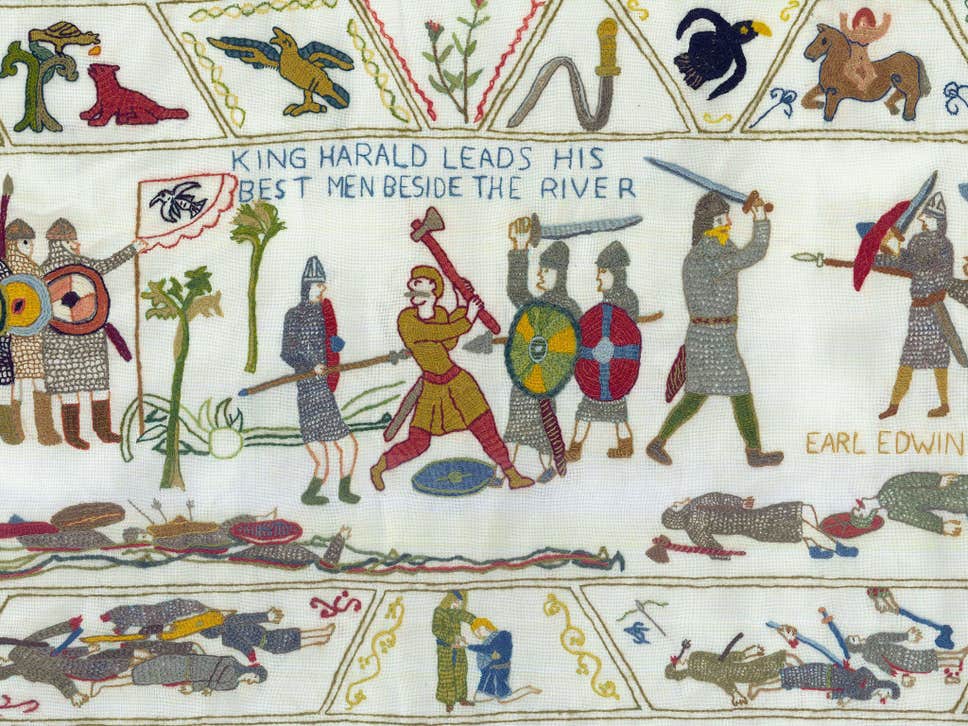 In the late summer of 1066, Hardrada and Tostig landed at Tyne, they proceeded to sack and burn the town of Scarborough and sailed up the River Ouse before advancing on the city of York.
They defeated an Anglo-Saxon army sent to meet them under the command of Edwin, Earl of Mercia and his brother Morcar, Earl of Northumbria at the Battle of Fulford on 20th September, after which York surrendered and hostages were demanded from the Northumbrians. [3] Hardrada took 150 children hostage from prominent families in Yorkshire as surety for their loyalty.
The Battle of Stamford Bridge
[2] Learning of the events at York, King Harold Godwinson raced northward with an English army from London a distance of about 185 miles, in only four days, and,on 25 September 1066, surprised his brother Tostig at Stamford Bridge.
Learning that the Northumbrians had been ordered to send hostages and supplies to the Vikings at Stamford Bridge, to the east of York. Harold advanced to attack them at this rendezvous point.
The Viking army, caught unaware by the English, was divided, with some of their troops positioned on the west side of the River Derwent and the bulk of their army on the east side.
[3] On 25th September Harold's army arrived at Stamford Bridge. Harold and twenty of his housecarls rode up to the foot of the bridge on the left bank of the Derwent and had a meeting with Tostig. Harold promised his brother that if he changed sides he would be rewarded with the return of his earldom and one-third of all England. Tostig declined.
The battle was in progress by the time the main English army had arrived at the scene, and the Vikings on the west side of the river had either been killed or were fleeing across the bridge. The English attempted to follow across the bridge but were delayed by the need for the army to pass through the bottle neck presented by the bridge itself.
An intersting account of the events says that a huge Viking berserker clutching a massive double-bladed greataxe blocked this narro w crossing, single-handedly holding up the entire Saxon army. The Anglo-Saxon Chronicle records that he slew up to 40 Englishmen. He was finally defeated when an Anglo-Saxon soldier floated under the bridge in a half-barrel and thrust his long spear through the laths in the bridge, mortally wounding him.
[3] During the battle Hardrada was killed by an arrow in the windpipe. Tostig was also killed and the rest were forced into the River Derwent, where large numbers drowned.
[3] The twenty-year-old Olaf Haraldsson, now in command of the Norwegians, asked for a peace settlement. Harold agreed and allowed the Vikings to return home. The Norwegian losses were considerable. Of the 300 ships that arrived, less than 25 returned to Norway.
[2] Following his death at Stamford Bridge, it is believed that his Tostig's body was buried at York Minster.
The Battle of Hastings
It is likely that the engagements at Fulford Gate and at the Battle of Stamford Bridge, fought within a week of each other, seriously affected Harold's strength at the Battle of Hastings, battle on October 14, 1066, that ended in the defeat of Harold II of England by William, duke of Normandy, and established the Normans as the rulers of England.
[4] Prior to the invasion, William controlled, directly or by alliance, every harbour from the Schelde to Brest. His father-in-law, Baldwin V of Flanders, was regent of France, and Geoffrey III, the count of Anjou and his only dangerous neighbour, was distracted by rebellion. With a solemn blessing from Pope Alexander II and the emperor’s approval, William prepared to enforce his claim to the English crown. The only obstacle to ithe invasion were the adverse winds preventing the crossing.
[4] Meanwhile Harold mobilized his fleet and army and in May, repelled his outlawed brother Tostig’s raids on the south and east coasts, and concentrated his large fleet off Spithead and his militia along the Hampshire, Sussex, and Kentish coasts
[4] the English militia, short of supplies after four months’ fruitless waiting, lost morale and were dismissed on September 8. Harold’s ships were brought back to the Thames, with many being lost en route. The English Channel was thus left open,
[On September 27 the wind changed, and William crossed to England unopposed, with an army of 4,000 to 7,000 cavalry and infantry, disembarking at Pevensey in Sussex. He quickly moved his forces eastward along the coast to Hastings, fortified his position, and began to explore and ravage the area
[Harold, at York, learned of William’s landing on or about October 2 and hurried southward, gathering reinforcements as he went. By October 13 Harold was approaching Hastings with about 7,000 men, many of whom were half-armed, untrained peasants.
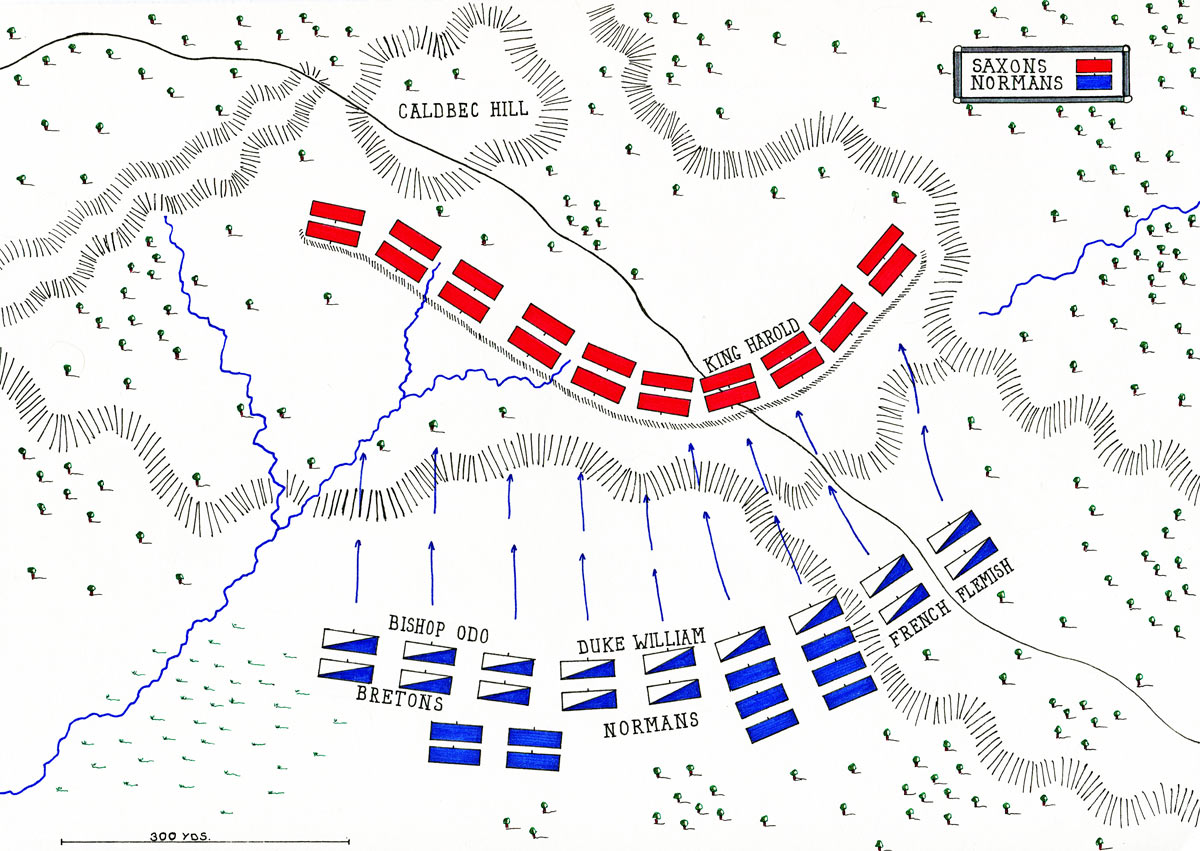 In what was to be a flawed trategy he advanced against William , instead of making William come to meet him in a chosen defensive position. At dawn on October 14 William moved toward Harold’s army, which was occupying a ridge 10 miles (16 km) northwest of Hastings.
Harold’s English army, lacking archers and cavalry, prepared for defense on the protected summit of the ridge. Their position was not wholly favourable; William’s advance was unexpected, and Harold had to fight where he stood or retreat
The summit of the ridge (where the high altar of Battle Abbey was later placed, Harold grouped his other troops along the crest for about 365 metres westward and about 180 metres eastward, at which points the slope became steep enough to protect both flanks. The front was too small: some men, finding no fighting room, withdrew; the rest, in too close order, made a perfect target for arrows.
The defense, hard-pressed, depleted, and tiring, was worn down and slowly outnumbered. Harold’s brothers, Gyrth and Leofwine, fell, and, according to the Bayeux Tapestry, Harold himself was killed late in the afternoon when he was struck in the eye by an arrow.
The Carmen Widonis
[5] The Carmen Widonis is the earliest history of the Norman invasion of England from September to December 1066, It is written in Latin and is attributed to Bishop Guy of Amiens, a noble of Ponthieu and monastically-trained bishop and administrator close to the French court, It takes the form of a Poem.
[6] One transalation is by Kathleen Tyson who has published it as ISBN 978149204751. It is interesting to compare the historical accounts with the content of this record of the events recorder immediately after the Battle. For example here is what it say about the Battle of Stamford Bridge
Meanwhile the accursed King Harold at the far end of the land
Honed treacherous blades to cut down a brother
For the brother had occupied no small part of the kingdom
Harold rushed the army to confront the enemy
He did not fear to deliver the limbs of a brother to death
Each to the other waged worse than civil war
But alas, Harold was the victor.
This account fits well with other accounts, so it has some credence.. Lets see what it says about the death of King Harold
When the duke spies the king above on the steep hill
His hard pressed men are being torn to pieces
The duke summons Eustace from the Franks then clearing the battlefield
Like a second Hector, the noble heir of Ponthieu
Hugh accompanies these ever ready for duty
Fourth is Gilfard, called by his father’s surname
Although many others join, these are the best of them
Harold is forced to go the way of all flesh
The first shatters his breast through the shield by a lance
The second by sword severs the head below the helmet
The third by spears pours out the belly’s entrails
The fourth cuts off the leg at the hip
The flying rumour ‘Harold is dead’ spreads through the battlefield
The defeated English refuse battle they demand pardon

Note that there is no mention of the "Arrow in the Eye" but that the killing weapon was a Lance and that was Harold was then hacked to pieces, Given that the Arrow theory is the result of an interpretation of the Bayeux Tapestry, the tapestry depict a lance, and the events described in the poem could be inferred, so this is another plausible interpreation.
References
1 Tostig Godwinson - Wikipedia
https://en.wikipedia.org/wiki/Tostig_Godwinson
2 Tostig Godwinson.
https://www.englishmonarchs.co.uk/saxon_31.html
3 Tostig Godwinson
https://spartacus-educational.com/MEDtostig.htm
4 Battle of Hastings | Summary, Facts, & Significance | Britannica
https://www.britannica.com/event/Battle-of-Hastings
5 Carmen de Hastingae Proelio - Wikipedia
https://en.wikipedia.org/wiki/Carmen_de_Hastingae_Proelio
6 https://saxonhistory.co.uk/Battle_of_Hastings_1066AD_Carmen_de_Triumpho_Normannico.php
https://saxonhistory.co.uk/Battle_of_Hastings_1066AD_Carmen_de_Triumpho_Normannico.php